Bills & Payments
Receiving, reading and paying your LPE bill, plus concessions and rebates, financial assistance, life support registration, family and domestic violence support, and our standard fees.
Receiving Your Bill
You will receive your first bill one month after you move in, and monthly thereafter. We will send your bill via email, or you can opt to receive your bill by post by logging in to My Account and changing your billing preferences.
Paying Your Bill
There are many ways you can pay your bill: via Direct Debit, BPAY or online via credit card. You can also pay online at Pay my bill.
Paying by Direct Debit
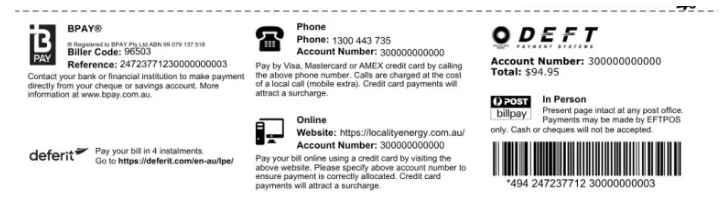
Located at the bottom of the first page of your bill you'll find a list of payment options available — including BPAY, by phone, online, Deferit or at your local post office.
Take note of your reference number, as you'll need this to pay your bill online or via BPAY, where you will also need to state the LPE biller code shown on your bill.
How to Read Your Bill
Our bills comply with the Better Bills Guidelines set out by the Australian Energy Regulator (AER).
Your bill is made up of several components, including your supply charge, electricity consumption, fees, charges, concessions, and GST.
On the back of your bill, you will find a detailed breakdown of all charges and any applicable deductions, along with information about your energy agreement.
- Consumption/Usage Charge — measured by a smart meter, this reflects the amount used at your property during the supply period. Consumption is measured in kilowatt hours (kWh) or litres (L), and the amount you pay per unit depends on your energy agreement.
- Supply Charge — a fixed daily cost for having any utility available at your property. The daily rate is determined by your current plan and is calculated over the number of days between bills.
- Other Charges/Adjustments — depending on your circumstances, you may receive rebates (credits) or incur additional fees and charges. You can find more details in our standard fees.
Concessions and Rebates
As a customer, you may be eligible for government energy concessions and rebates that can be applied to your electricity account. Eligibility requirements and available concessions vary by state (please see further information below).
In most cases, you must:
- Be the electricity account holder.
- Hold a valid concession card.
- Use the property as your principal place of residence.
- Meet any additional requirements set by your state government.
If you believe you may be eligible, please contact our Customer Support Team on 1300 333 111 and we can help you understand the options available to you.
Queensland
You may be eligible for an electricity rebate if you hold one of the following:
- Queensland Seniors Card
- Pensioner Concession Card issued by Services Australia or the Department of Veterans' Affairs (DVA)
- Health Care Card issued by Services Australia*
- DVA Gold Card
- Asylum seeker status (electricity rebate only)
* Includes Low Income Health Care Card and Ex-Carer Allowance (Child) Health Care Card holders.
Generally, you must be the account holder and either live alone or only with your spouse, dependants, other eligible concession card holders, or approved carers who do not pay rent.
More information: Queensland Government — electricity and gas rebates
Financial Assistance
We understand that financial difficulties can happen. Whether you are facing short-term challenges or longer-term hardship, we are here to help.
Our team is here to support you and create a plan that works for your situation.
- Due Date Extension — if you need a little extra time to pay, you can request an extension of your bill's due date. This option may be suitable if you expect to be able to pay in full soon but require a short-term adjustment.
- Payment Plans — flexible payment arrangements can be set up to allow you to pay your account in smaller, more manageable amounts over time. These plans are tailored to your circumstances (see payment plans), helping you stay on top of your bills without added stress.
- Home Energy Emergency Assistance Scheme (HEEAS) — QLD only — if you are a Queensland resident experiencing a financial crisis or severe hardship, you may be eligible for government support through HEEAS. This scheme provides a one-off payment to help you maintain essential energy supply during times of genuine emergency.
- Hardship Support — if you are experiencing longer-term or ongoing financial difficulties, you may qualify for our hardship program. This program (see our hardship policy) offers personalised support, including tailored payment plans and protection from disconnection while you actively participate in the program.
- Centrepay — eligible customers receiving Centrelink payments can choose to have regular deductions made directly from their Centrelink benefits to help manage and pay their utility bills. This can provide peace of mind by ensuring consistent and automatic payments. More information can be found at Centrepay.
- Extra support — other support may be available to you, including concession rebates provided through Centrelink in the form of Pension Concession Cards, Health Care Cards or a Repatriation Health Care Card (Gold Card) through the Department of Veterans' Affairs.
Our team can guide you through the options available, including concessions and rebates. Call us today on 1300 333 111 to discuss a payment plan that works for you.
Life Support
When you register life-support equipment with LPE we:
- Record the requirement at your supply address and keep it up to date.
- Make sure you receive advance written notice of any planned outages affecting your supply so you can make alternative arrangements.
- Work with the network distributor to minimise the risk of disconnection or de-energisation where life-support equipment is in use.
How to register
- Call our Customer Support team on 1300 333 111.
- We will send you a Medical Confirmation Form (either by email or post). Have your medical practitioner complete and return this form to confirm that the equipment is required.
- Once we receive the completed form, we will register the life-support requirement for your supply address and notify the distributor. We'll confirm registration with you and explain the protections available.
Eligibility
If you, or a person residing or intending to reside at your premises, requires any of the equipment below, you are eligible to apply for the Life Support Program:
- An oxygen concentrator
- An intermittent peritoneal dialysis machine
- A kidney dialysis machine
- A chronic positive airways pressure respirator
- Crigler-Najjar syndrome phototherapy equipment
- A ventilator for life support
- Any other equipment that a registered medical practitioner certifies as required for life support
Electricity supply is not guaranteed
Storms, cyclones, bushfires, and other unforeseen events — such as vehicle accidents involving power poles — can affect the electricity network and result in unplanned outages. The distributor will act as quickly as possible to restore supply, however they cannot guarantee continuous electricity or restoration within a specific timeframe.
Please note that being registered in our Life Support Program does not ensure an uninterrupted power supply or prioritised restoration during an outage. If uninterrupted power is critical, we strongly recommend speaking with a licensed electrical contractor about backup supply options.
It is also essential to have a plan in place with your doctor or life support equipment provider to ensure you are prepared and supported in the event of a power interruption.
Family and Domestic Violence
If you are in a situation where you are affected by family and domestic violence, please contact LPE for assistance with your utility account.
There are a number of different support options available to anyone in this situation. Below is a list of support services that may be able to assist you.
| Service | How they can help | Contact details |
|---|---|---|
| Police | If you or your child/family is in immediate danger | Call 000 |
| Services Australia | Centrelink, Medicare, Child Care. Social workers can provide short-term counselling, support and information, and refer you to other support services | Social Work Services: call 13 28 50 Multilingual: call 13 12 02 Visit Services Australia |
| Lifeline | Crisis support services | Call 13 11 14 Open 24/7 |
| 1800 RESPECT | Free, confidential family violence and sexual assault counselling services | Call 1800 737 732 Open 24/7 Visit 1800 RESPECT |
| Relationships Australia | Counselling, mediation and family dispute resolution services | Call 1300 364 277 Local call cost from anywhere in Australia |
| Financial Counsellor — National Debt Helpline | Free help in managing bills and debts, or financial independence | Call 1800 007 007 Visit National Debt Helpline |
| Community Legal Centres Australia | A directory of community law centres in Australia | Visit Community Legal Centres |
| Women's Legal Services Australia | Legal centres specialising in women's legal services | Visit Women's Legal Services |
| Family Relationship Advice Line | Information and advice on family relationship issues and parenting arrangements after separation | Call 1800 050 321 Mon–Fri 8am–8pm, Sat 10am–4pm |
| 13YARN | Free, confidential crisis support for Aboriginal or Torres Strait Islanders | Call 13 92 76 Open 24/7 Visit 13YARN |
| QLife | Free LGBTI peer support to chat through a range of issues | Call 1800 184 527 Open daily 3pm–midnight Visit QLife |
| MensLine Australia | Free support services for men | Call 1300 78 99 78 Open 24/7 Visit MensLine |
What is family violence?
Family violence occurs when one person in an intimate personal or family-like relationship uses violence or abuse to maintain power and control over the other person. Family violence may take different forms, may be known by different names such as relationship violence or intimate partner violence, and is not limited to physical violence.
Family violence can include, but is not limited to:
- Emotional or psychological abuse
- Verbal abuse
- Financial or economic abuse — a form of abuse where one partner has control over the other partner's access to economic resources, diminishing their capacity to support themselves so they become financially dependent on the perpetrator. For example, the perpetrator prevents a person from accessing funds, decides when or how to access or use cash, forces them to put bills in their name, or puts bills under their own name and then does not take financial responsibility for them. Essential services such as electricity can be used by perpetrators of family violence to coerce and cause harm as a form of economic abuse, due to the critical function essential services play in daily life.
- Physical or sexual abuse
- Threatening or coercive behaviour
- Any other behaviour that controls or dominates you and causes you to fear for your safety or wellbeing, or that of someone else
LPE recognises that family violence can happen to anyone, in any community. It can be used by a perpetrator to significantly undermine a person's rights, inhibit their options, undermine their safety, mental and physical health and wellbeing, and limit opportunities for learning and participation, access to material basics and economic wellbeing, relationships and connections.
How we can help
LPE recognises our customers may be exposed to family violence and we are committed to actively supporting customers who may be affected.
We are committed to providing a supportive and confidential environment where you can inform us of your circumstances and seek the support you need.
Download PDF: Family Violence Policy
Our Standard Fees
You may incur additional fees and charges as part of your account. Please refer to the current standard charges listed below. All prices include GST unless otherwise stated.
If you have any questions, please reach out to our team for assistance.
View our standard fees: LPE Standard Fees